
When to use a UV curing TIJ ink cartridge instead of solvent
Use a UV curing TIJ ink cartridge when your application needs a cured mark and your line can support a matched UV lamp, shielding, and process validation. Start with solvent TIJ when an evaporation-dried mark already meets the handling and resistance requirements. UV is a system choice, not a drop-in upgrade for every cartridge printer.
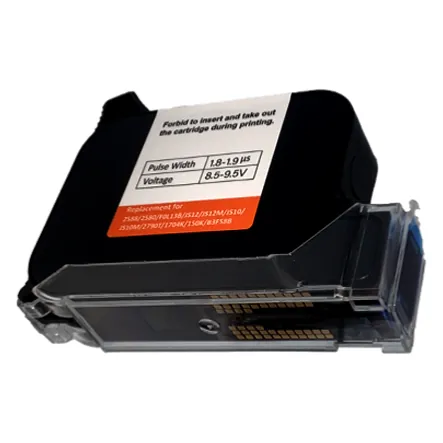
MufengTech lists a خرطوشة تصلب بالأشعة فوق البنفسجية (UV) alongside its black solvent quick-drying cartridges. This guide covers the solvent vs UV TIJ decision at the application-trial stage. It does not assume that an existing handheld or online controller supports either formulation without confirmation.
Separate curing from drying and UV detection
Solvent TIJ relies mainly on solvent evaporation after the printer deposits the ink. Drying behaviour changes with the material, coating, temperature, airflow, and ink deposit. A mark that feels dry can still fail a rub or chemical-resistance test.
UV-curable ink needs suitable UV exposure to form its cured film. The lamp, exposure, and ink chemistry must work together. A small inspection torch is not a substitute for a validated curing unit.
Do not confuse UV curing with invisible UV-readable TIJ ink. An invisible mark may fluoresce under UV inspection light. That describes how the mark is detected, not how it cures. Ask separately whether an ink needs a curing lamp.
Compare solvent vs UV TIJ against the next production step
| Application question | Start with solvent TIJ when... | Investigate UV-curable TIJ when... |
|---|---|---|
| What happens after printing? | The mark can dry before guides, rollers, or packing contact it | You can install curing before the first contact point |
| What resistance is needed? | The selected solvent ink passes the customer's tests | A validated cured formulation may address a failed resistance requirement |
| What does the line support? | No curing unit is planned | There is room for a guarded lamp and its controls |
| How stable is product travel? | The drying interval remains adequate across the operating range | Exposure can remain controlled during speed changes and stops |
| What evidence is available? | Production-material trials meet the acceptance criteria | Trials include cure assessment as well as print quality |
Neither column promises adhesion on every plastic. Coatings, surface treatment, release agents, and contamination can change the result even within one material family. Test the actual supplied packaging, not a generic sample described only as PET or PP.
Use the published cartridge details as a compatibility checklist
The MufengTech UV page lists black 2MKBK611 and white 2MKWT612. Both entries show 42 ml volume, 12.7 mm print height, 10 V firing voltage, and 1.7 microsecond pulse width. The same table lists pulse warming on at 40°C.
These are product-page parameters, not instructions to change a controller yourself. Ask MufengTech to confirm the current data sheet and the approved controller profile for the supplied batch. Cartridge geometry, electrical settings, recognition, and firmware support all matter.
The solvent page lists black MFK708 and MFK709 at 12.7 mm, and MFK706 at 25.4 mm. Their listed drive settings differ from the UV entries. That difference is one reason a cartridge that fits the holder is not automatically ready to print.
Ask for curing data the public page does not specify
The reviewed UV page does not publish a matched lamp wavelength, required dose, lamp distance, or validated production speed. Request those details before choosing the lamp or promising output to a customer. Do not borrow a competitor ink's lamp settings for MufengTech cartridges.
Ask how to verify cure, what handling interval applies, and which cleaning method is approved for the printhead. For white ink, also request any formulation-specific handling instructions. Do not assume every white formulation needs the same agitation procedure.
Check whether the line can support curing
Map the route between the printhead and the next contact point. Identify guards, conveyor rails, sensors, and reflective surfaces. Place the proposed cure station where the full printed area receives the specified exposure before a roller or packed product touches it.
Line speed changes exposure time. A stopped product may receive excessive exposure or heat if the lamp controls do not respond correctly. Review start, stop, missing-product, and fault conditions with the integrator. Arrange suitable shielding and interlocks so operators cannot look into the lamp or expose skin to the curing light.
Keep UV light away from the nozzle plate and uncured ink at the printhead. Stray or reflected light can cure ink where it is not wanted. Follow the ink and lamp suppliers' instructions for positioning, protective equipment, ventilation, and waste handling.
Run a trial that can reject the wrong option
Agree on the acceptance criteria before requesting samples. Include code readability, contrast, transfer to adjacent material, and the resistance relevant to the product's use. If the code is machine-readable, inspect it with the intended reader after handling tests.
- Send the exact material, coating details, code artwork, line conditions, and controller model to the supplier.
- Test a suitable solvent cartridge as the baseline where practical. Record whether it meets the required drying interval.
- If UV remains justified, obtain the confirmed cartridge profile and matched curing specification.
- Print and cure at the proposed production conditions, including speed changes and normal stops.
- Check cure with the supplier's approved method. Repeat the customer's rub, handling, and chemical-exposure tests.
- Record the ink batch, controller profile, lamp conditions, results, and limits before approving the application.
Do not infer complete cure from a dry-looking surface alone. Do not claim food-contact suitability because a mark is UV cured. Food applications need separate formulation-specific documentation and an assessment of the intended contact conditions.
Send an enquiry that covers the whole system
Ask MufengTech about the ink, controller support, curing specification, and sample-test plan in one enquiry at [email protected]. Describe what fails with the current mark rather than requesting UV solely because it sounds more durable.
Browse the TIJ cartridge range for formulation options. For an equipment project, use the Shenzhen Mufeng Technology catalogue. If cartridge TIJ cannot meet the product geometry or installation constraints, the CIJ equipment range is a separate technology to assess.
FAQ: When to use a UV curing TIJ ink cartridge instead of solvent
Does every UV curing TIJ ink cartridge need a lamp?
A UV-curable formulation needs a suitable curing source and the specified exposure. Confirm the lamp requirements for the exact ink. Do not substitute UV inspection light for curing equipment.
Can I put UV ink in my solvent TIJ printer?
Only after the supplier confirms controller support, cartridge recognition, drive settings, and the curing installation. A matching physical size alone is insufficient.
Is UV TIJ always more resistant than solvent TIJ?
No. Resistance depends on the formulation, material, cure, and test conditions. Compare the two options on the actual production material against the same acceptance criteria.
Is UV-curable ink automatically suitable for food packaging?
No. Request documentation for the exact ink and intended contact conditions. Curing does not establish food-contact suitability or regulatory acceptance.
Written by the team at Shenzhen Mufeng Technology Limited Company. WhatsApp: +86 158 1405 1051